
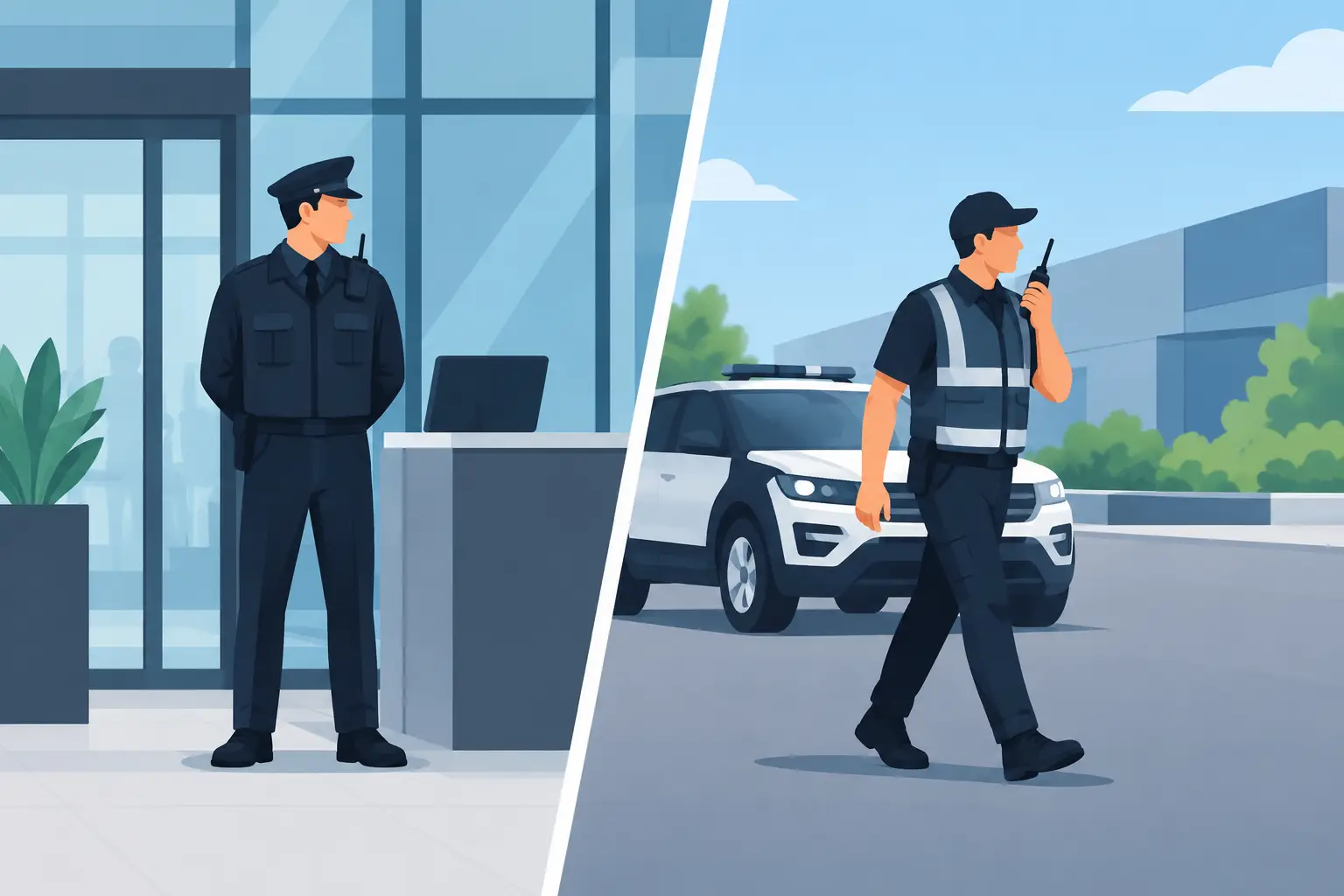
A vacant construction gate at 2am needs a different response from a busy retail entrance at 2pm. That is the practical starting point for static guarding versus mobile patrol. Both services protect people, property and operations, but they provide cover in very different ways – and they create different demands for employers and security professionals.
For clients, the right choice affects visibility, response times, budgets and risk control. For candidates, it affects shift patterns, responsibilities, vehicle requirements and the skills that make an application stand out. The strongest security arrangements are rarely chosen by habit. They are matched to the site, the threat level and the hours when protection matters most.
What static guarding delivers
Static guarding places a security officer at one defined location for an agreed shift. That could be a reception desk, gatehouse, retail floor, hospital entrance, logistics yard, data centre or residential development. The officer is a continuous, visible presence, often acting as the first point of contact for staff, visitors, contractors and emergency services.
This model suits sites where access must be managed throughout the day or night. A static officer can check identification, issue visitor passes, monitor alarms and CCTV, complete patrols within the premises, carry out fire and safety checks, and respond immediately when an incident develops. They also build familiarity with normal activity. That knowledge can make unusual behaviour easier to spot.
The value is not simply that someone is present. A capable officer understands site procedures, knows who should be there, keeps accurate records and communicates calmly when a situation changes. In customer-facing settings, professionalism matters as much as vigilance. A receptionist-security officer in a corporate building may be dealing with deliveries one moment and access-control concerns the next.
For employers, static guarding usually provides the greatest certainty of cover. There is an officer on site for every contracted hour. The trade-off is cost: continuous manned guarding requires scheduled shifts, relief planning, supervision and cover for holidays or sickness. On a low-traffic site with few overnight incidents, that level of provision may not be necessary.
How mobile patrols work
Mobile patrol services use trained officers who travel between several client locations, often in marked vehicles. Their work may include scheduled external checks, random patrols, alarm response, lock and unlock duties, keyholding, perimeter inspections and welfare visits for lone workers.
A patrol officer is not permanently based at one property. Instead, the service provides regular, documented visits and a response capability across a defined area. This can be an effective approach for empty offices, small industrial units, compounds, schools, car parks and sites that are closed outside operating hours.
The visible arrival of a patrol vehicle can be a strong deterrent, particularly when visit times vary. Mobile officers can also identify issues that do not require a full-time guard: an unsecured gate, damaged fencing, a triggered alarm, signs of trespass or a safety concern in an isolated building.
However, mobile patrol is not the same as constant observation. There will be periods when no officer is physically present. If a location has frequent public access, high-value stock, repeated incidents or a requirement for immediate intervention, patrol-only cover may leave a gap. Employers should be clear about expected response arrangements, call-out procedures and what happens if several alarms activate at once.
Static guarding versus mobile patrol: key differences
The choice usually comes down to presence, frequency and risk. Static guarding offers continuous on-site cover and close control of a specific environment. Mobile patrol offers flexible checks across multiple locations, often at a lower cost than a full-time officer.
A distribution centre operating around the clock may need a static officer to manage vehicle movements, contractor access and site safety. A small warehouse that closes at 6pm may be better served by a locking visit, intermittent patrols and alarm response. A retail centre may need both: static officers during trading hours and patrol support after closing.
Risk assessment should lead the decision. Consider the value and attractiveness of assets, the site layout, local incident history, public access, lone-working exposure, insurance requirements and the consequences of a delayed response. It is also worth considering operational reputation. A poorly managed access point or repeatedly unsecured premises can affect staff confidence, customer experience and client relationships.
Cost should be assessed honestly rather than treated as the only factor. Mobile patrol can reduce costs where a permanent presence is unnecessary, but it cannot deliver the same immediate intervention as a static officer. Static guarding costs more because it commits a qualified person to the site, yet that presence may prevent losses, disruption or safety failures that are far more expensive.
Career differences for security professionals
Static and mobile roles both require reliability, good judgement and clear reporting, but the working day feels very different. Candidates should look beyond the job title and read the duty list, shift pattern and licensing requirements before applying.
Static security officer roles
Static positions often suit officers who are confident working within a defined team and site routine. The role may involve long shifts, reception duties, access control, visitor management, CCTV observation, internal patrols and detailed incident reporting. Strong communication is essential, especially in corporate, healthcare, retail and residential settings.
A consistent location can help an officer develop specialist site knowledge and build trusted working relationships with management and staff. It may also offer a clearer route into supervisory, control-room or facilities-security responsibilities. That said, some sites can be demanding during busy periods, and officers must remain alert even when activity appears routine.
Mobile patrol officer roles
Mobile patrol work appeals to officers who prefer variety, independent working and time on the road. A typical shift can involve visiting several locations, completing electronic patrol reports, responding to alarms, checking vacant premises and dealing with unexpected incidents without immediate on-site colleagues.
Employers commonly look for a valid driving licence alongside the relevant PSA or SIA licence, depending on the jurisdiction and role. Candidates need sound judgement, strong route discipline, confidence using reporting systems and the ability to stay calm when arriving at an alarm activation or potential break-in. Night work is common, and shift patterns can be less predictable than a fixed-site role.
For many professionals, mobile patrol experience is a valuable route into response management, keyholding, security supervision or operational control-room work. It demonstrates that an officer can work independently, follow procedure and represent the company professionally across different client premises.
What employers should specify in a vacancy
A vague advert attracts vague applications. Whether recruiting for static guarding or mobile patrol, employers should state the location, work pattern, pay, licence requirement, start date and core duties. For mobile positions, make clear whether a company vehicle is provided, whether a full driving licence is essential, the geographical coverage area and any keyholding or alarm-response responsibility.
For static roles, explain the environment. A front-of-house post requires a different approach from a gatehouse at an industrial facility. Candidates should know whether the work involves public interaction, CCTV, searches, access systems, report writing, fire warden duties or lone working. Clear information improves application quality and helps candidates assess whether the role genuinely suits their experience.
Licensing must be addressed accurately. Employers in the Republic of Ireland should specify the relevant PSA requirements, while roles connected to Northern Ireland may require the appropriate SIA licence. If training or licence-track applications are accepted, say so plainly rather than allowing qualified candidates and new entrants to compete under unclear expectations.
A blended model can be the right answer
The decision is not always static guarding or mobile patrol. Many clients need a combination that changes with operating hours and risk. A static officer may cover daytime access and visitor management, while a mobile team locks down the site, conducts overnight visits and responds to out-of-hours alarms.
This approach can provide strong security where it is most needed without paying for permanent cover during quiet periods. It also requires proper handovers. Static and mobile teams need shared instructions, accurate site information and a clear escalation process. A missed key detail, such as a contractor left on site or a faulty access point, can undermine an otherwise well-planned service.
For candidates, understanding this blended model can widen job opportunities. A role may begin as fixed-site guarding but include relief work, patrol support or control-room communication. Flexibility is valuable, provided the duties, training and pay reflect the responsibility involved.
The best security role or service is the one that matches the real working environment, not the cheapest label on a quote. Security Jobs Ireland helps employers and licensed professionals connect around those practical requirements, from permanent site coverage to mobile, response-led work. Choose the role or staffing model with clear eyes: know the location, understand the risk, confirm the licence requirements and make sure the level of cover matches what is actually at stake.