
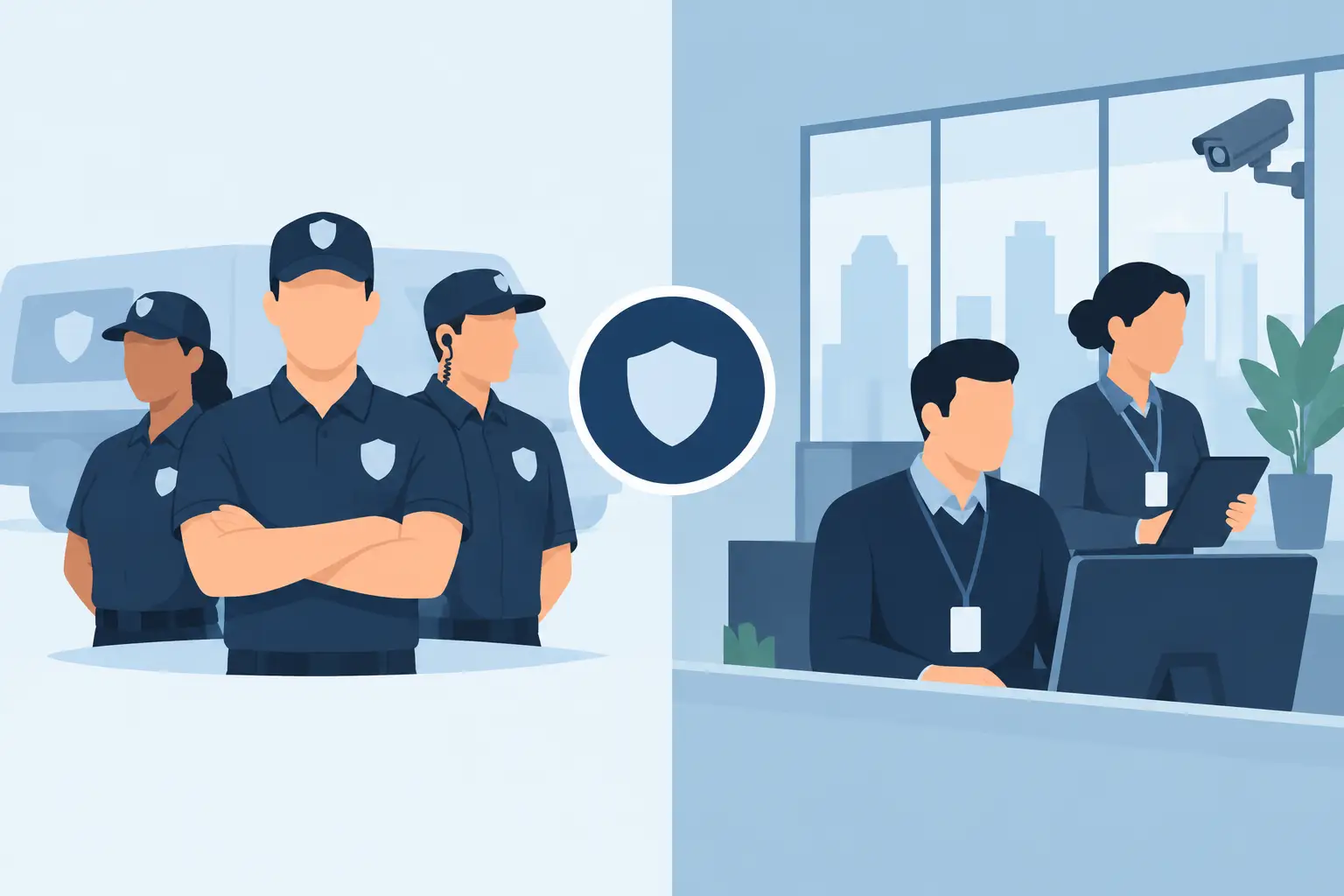
A vacant shift at a retail park, construction site or healthcare facility is not simply an admin problem. It can mean an unsecured entrance, a missed patrol, pressure on the remaining team and a difficult conversation with the client. The contract security versus in-house decision should therefore start with the reality of the site: the risks, the hours to cover, the skills required and the people available to do the work.
Neither model is automatically better. Contract security can provide speed, scale and operational cover. An in-house team can offer greater day-to-day control and stronger connection to one workplace. The right choice depends on whether your priority is flexibility, continuity, specialist capability, budget certainty or long-term workforce ownership.
What contract security gives an employer
Contract security means engaging a licensed security provider to supply officers, supervisors and, where needed, specialist services. The provider employs the staff, manages recruitment and normally takes responsibility for rosters, relief cover, supervision and payroll.
For sites with changing requirements, this can be a practical route. A logistics operation may need increased gatehouse coverage during peak periods. An events venue may require a trained team for particular dates rather than a permanent headcount. A construction project may need mobile patrols at one stage and static guarding once valuable equipment arrives. A contract provider can adjust staffing levels without the employer having to recruit, vet and employ every officer directly.
The ability to arrange cover is a major advantage. Holidays, sickness, resignations and unexpected absences are part of security operations. A capable contractor has a wider pool of licensed staff and a relief plan, reducing the risk that one absence leaves a critical post unattended. This is especially valuable for 24-hour sites and locations outside major urban areas, where replacing an officer at short notice can be difficult.
Contract arrangements can also bring management structure. Established providers may supply site instructions, incident reporting processes, supervisory visits, training records and performance reviews. For employers without a dedicated security manager, that expertise can reduce the operational burden.
There is a trade-off. The quality of service depends heavily on the provider, the contract specification and the calibre of the officers assigned. A low price that leaves little room for training, supervision or fair pay can lead to frequent staff changes. The client may then spend time repeatedly explaining site procedures to new people, losing the very continuity security is meant to provide.
When an in-house security team makes sense
An in-house team is employed directly by the organisation it protects. This model is often strongest where security is closely tied to the daily operation, culture and customer experience of the business.
For example, a corporate campus, hospital, large manufacturing facility or transport operation may benefit from officers who know the building layouts, keyholders, staff routines, recurring risks and emergency plans in detail. Over time, that knowledge can improve incident prevention and response. A familiar officer at reception or on patrol can also build trusted relationships with employees, tenants and visitors.
Direct employment gives the organisation greater influence over recruitment, training, uniform standards, shift patterns and career development. It can create a clearer progression route from officer to control room operator, team leader or security manager. Where a business wants security staff to become a permanent part of its operations, this level of ownership can be valuable.
However, in-house security is not simply a matter of putting officers on the payroll. The employer takes on recruitment, employment contracts, vetting, licence checks, payroll, pensions, absence management, training, scheduling and disciplinary processes. In the Republic of Ireland, relevant personnel must hold the appropriate PSA licence for the work they perform. In Northern Ireland, employers must ensure applicable staff hold the required SIA licence. These checks must be maintained, not treated as a one-off exercise at hiring.
Relief cover is another operational test. A small in-house team can work well until two officers are off sick, a new post is added or someone leaves without a long notice period. Unless there is a reliable bank of trained relief staff, managers may find themselves trying to fill security shifts at very short notice.
Contract security versus in-house: compare the full cost
The hourly rate is rarely the full cost of either model. A meaningful comparison looks at what is included, who carries the employment responsibility and what failure would cost the site.
With contract security, the stated price may include recruitment, employer costs, uniforms, management, replacement cover and the provider’s margin. Ask what is included in the service agreement and what attracts additional charges. Are supervisory visits included? Is there an out-of-hours escalation process? How quickly is a replacement officer supplied? Does the rate cover the required licence category and any site-specific training?
With an in-house team, the visible wage is only one element. Employers should allow for annual leave, sickness, pension contributions, payroll administration, uniforms, training, vetting, equipment, management time and the cost of maintaining relief cover. If the operation needs a supervisor or security manager, that role should be included too.
The better question is not, “Which option has the lowest rate?” It is, “Which arrangement provides dependable coverage at the level of risk this site carries?” An unmanned gate, poor incident reporting or an officer without the right training can create costs that are far greater than a small difference in labour spend.
Start with the role, not the staffing model
Employers sometimes choose a model before defining what officers will actually be expected to do. This creates vague job descriptions and unclear service expectations, whether the staff are contracted or employed directly.
Set out the core duties first. A CCTV operator needs different competence from a door supervisor. A mobile patrol driver needs a suitable driving record, local route knowledge and a clear response process. A front-of-house officer may require strong customer service skills alongside access control and emergency procedures. Close protection and cash-in-transit work demand specialist experience and licensing.
Then consider the working pattern. Is the requirement daytime reception cover, a permanent night shift, weekend support, or 24-hour guarding? Is the post static, mobile or spread across several sites? Are there predictable busy periods, such as retail trading hours, event dates or project milestones? Clear answers make it easier to decide whether a fixed in-house team or a flexible contract arrangement is more realistic.
Recruitment and retention will shape the result
Security staffing is a people decision before it is a procurement decision. A well-written specification cannot compensate for poor recruitment or a workplace where officers feel unsupported.
For in-house hiring, employers should make the vacancy specific: location, licence requirement, pay, shift pattern, responsibilities and any essential experience. Candidates are more likely to apply when they can see whether the role fits their travel, family commitments and career plans. Direct recruitment also allows the employer to present its workplace culture and progression opportunities from the outset.
For contract security, assess how the provider recruits and retains officers. Ask about staff turnover on comparable sites, average time to fill vacancies, training arrangements and how often assigned officers are moved between contracts. Request clarity on who manages the team and who the client contacts when standards slip.
Security Jobs Ireland can support employers seeking licensed professionals directly, helping them reach candidates who understand security roles, licence requirements and local work patterns. Whether you are building an in-house team or assessing the market before appointing a contractor, access to relevant candidates gives you a more informed starting point.
A blended model can be the sensible answer
The choice does not always have to be absolute. Some organisations retain a small in-house security management team and use a contractor for frontline cover. Others employ core officers directly for critical posts, then use contract staff for seasonal demand, major projects, holidays or events.
This approach can protect site knowledge while giving the operation room to respond to changing demand. It needs careful coordination, however. Everyone must work from the same site instructions, incident reporting procedures, access rules and escalation contacts. Two teams with different standards create confusion, not resilience.
Questions to resolve before you decide
Before committing to either option, test the decision against four practical questions:
- Can the model provide properly licensed, vetted officers for every required shift, including short-notice cover?
- Who owns supervision, performance management, training records and incident follow-up?
- Does the pricing account for annual leave, absence, management time and relief staff rather than only base pay?
- Will the team understand the site well enough to prevent incidents, communicate professionally and respond correctly under pressure?
If the answers are unclear, the specification is not ready. Clarifying them before recruitment or tendering will save time and protect service quality later.
The strongest security arrangement is the one that keeps the right people in the right posts, with clear standards and accountable management. Start by defining the work your site genuinely needs, then choose the employment model that gives your officers the support to do it well.