
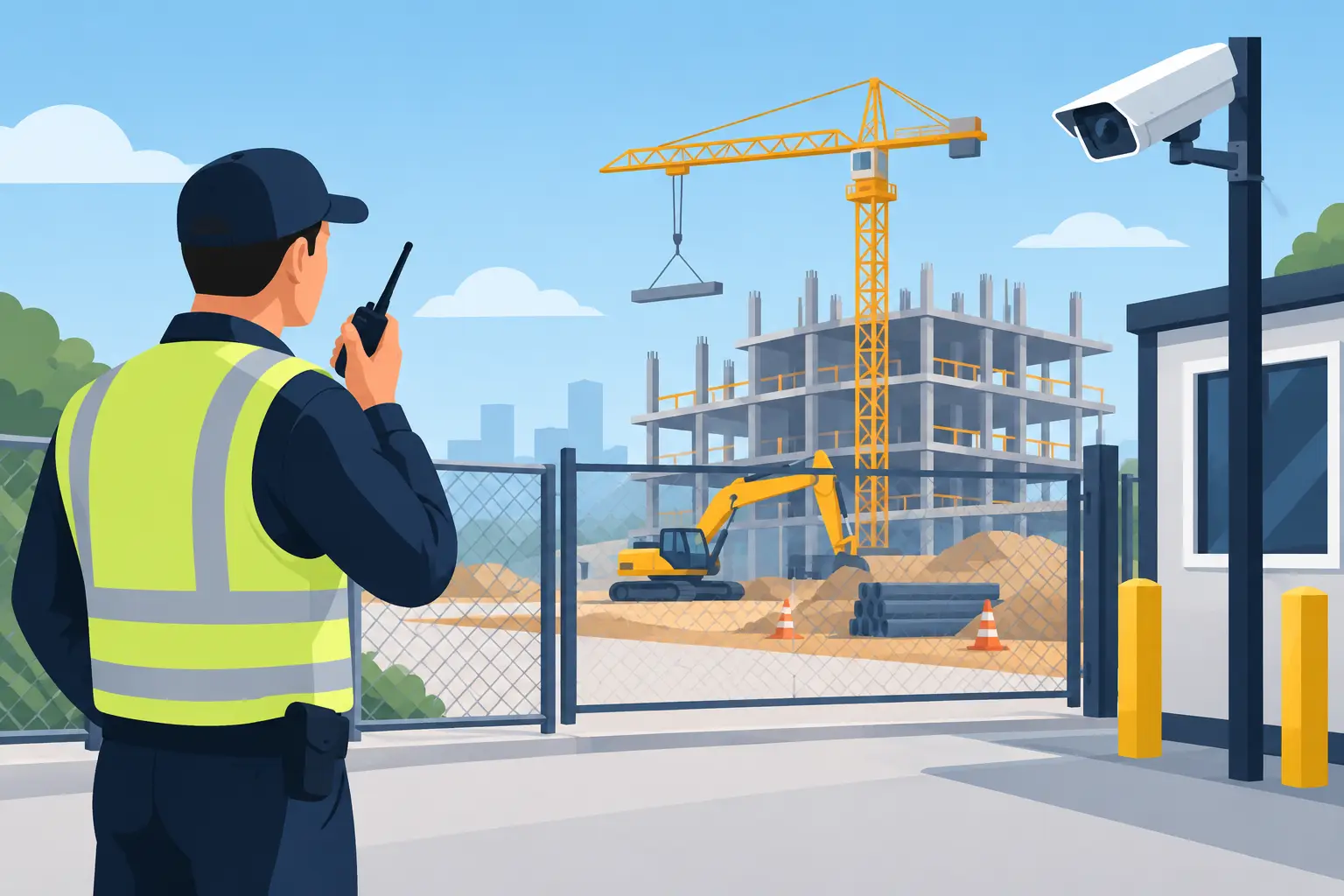
A construction site security example is most useful when it reflects the changing reality of a live project, rather than simply placing one officer at a gate. A half-built housing scheme, warehouse extension or roadworks compound can present a different risk profile every month. Plant arrives, contractors multiply, materials become more valuable, boundaries move and public access points change.
For employers, the aim is straightforward: protect people, plant, materials and programme deadlines without paying for cover that does not match the site’s actual risk. For security professionals, a clear assignment gives the officer authority, workable procedures and the information needed to respond properly.
Construction site security example: a live housing development
Consider a 60-unit housing development on the edge of a town. The site has one vehicle entrance, a pedestrian turnstile, temporary fencing, a site office, fuel storage, a compound containing tools and materials, and several partially completed properties. Work runs from 07:30 to 17:30 on weekdays, with occasional Saturday shifts. Neighbouring homes sit along one boundary.
The principal contractor has experienced minor tool thefts and repeated attempts to enter through a damaged rear fence. There have also been complaints about youths entering the site after dark. The immediate priority is not just stopping theft. It is preventing injury, arson, vandalism, unauthorised vehicle access and delays caused by missing equipment.
A proportionate security plan could use a licensed static security officer at the entrance during working hours, supported by scheduled patrols. Out of hours, the contractor may use mobile patrol visits, CCTV monitoring or a dedicated night officer, depending on the value of plant, previous incidents and the site’s location. There is no single correct model. A remote rural site holding high-value machinery may need stronger overnight protection than a busy urban site with passive surveillance from nearby residents.
Daytime access control
At the start of each shift, the security officer opens the access point in line with the site manager’s instructions, checks that visitor procedures are ready and confirms any planned deliveries. Contractors sign in or use the agreed digital system, while visitors are directed to the site office and issued with the correct pass or escort arrangements.
The officer should not attempt to replace the site manager, banksman or health and safety team. Their role is to control entry, challenge unfamiliar persons professionally, observe unsafe access behaviour and report concerns promptly. If a delivery driver arrives without a booking, the officer verifies the instruction before allowing entry. This avoids lorries waiting in unsafe positions, unplanned congestion and materials being left at an unsecured perimeter.
At departure, the officer records visitor sign-out, checks that gates are secured when required and reports any irregularity. A practical handover note might record a contractor who has not signed out, a broken padlock, a delivery expected before 08:00 the next day, or a section of fencing awaiting repair.
Patrols that serve a purpose
Patrols should be based on risk, not performed merely to fill a logbook. On this housing site, the officer’s route includes the fuel store, plant keys, tool compound, rear fence line, scaffold access points, vacant plots and site offices. Routes and timings should vary where possible, particularly out of hours, so they are not predictable.
During each patrol, the officer checks for forced entry, fence damage, unsecured doors, signs of trespass, fire hazards and suspicious vehicles. They also look for conditions that could create a security weakness later, such as stacked materials providing a route over fencing or poor lighting near the rear boundary.
Observations need to be specific. “All clear” has little value after an incident. “Rear fence panel beside Plot 42 displaced by approximately 30 cm; photograph taken; site manager notified at 18:15” creates an accountable record and allows the contractor to act.
Building the assignment around the project stage
Security requirements change as construction progresses. Early groundworks may centre on protecting plant, diesel and temporary cabins. Once the structure is enclosed, the risk often shifts towards tools, copper, appliances, internal fittings and arson. At final fit-out and handover, multiple subcontractors, buyers, inspectors and delivery teams can make access control more demanding than the earlier build phase.
A good site security provider reviews the assignment at agreed intervals and after any serious event. The review should consider recent losses, changes to the perimeter, the value of materials on site, working hours, local antisocial behaviour and whether CCTV, lighting and physical barriers are still positioned effectively.
This matters for staffing as well. A lone night officer may be suitable for a stable, well-lit site with reliable communications and clear escalation arrangements. It may not be suitable where repeated intrusions, large grounds or confrontational behaviour are likely. In that case, mobile support, a two-officer response or additional technology may be justified.
The officer’s instructions must be site-specific
Generic instructions create gaps. Every officer assigned to a construction site should receive a proper induction and written assignment instructions before working alone. These should identify the client contact, site manager, emergency contacts, muster point, restricted zones, patrol schedule, keyholding arrangements, welfare facilities and reporting process.
They should also be clear on boundaries. Security officers can deter, observe, challenge and report within their training and legal powers, but they should not take unnecessary risks to recover property or confront groups without support. Personal safety, communication and timely escalation come first.
For a site in the Republic of Ireland, employers should ensure deployed personnel hold the relevant PSA licence for the work. In Northern Ireland, the applicable SIA licensing requirements apply. Licence checks are a starting point, not the whole standard. Construction security work also depends on reliability, report writing, customer service, awareness of health and safety controls and the confidence to deal calmly with contractors, visitors and members of the public.
Reporting turns security activity into evidence
The strongest construction site security example includes a reporting chain that the client will actually use. Daily occurrence reports should cover staffing times, patrols completed, deliveries, visitors, defects, incidents and actions taken. Photographs can support reports of damaged fencing, unsecured access points or suspicious activity, provided they are handled in line with the employer’s procedures.
Incident reports need enough detail to support follow-up. Record the time, exact location, persons involved, description of events, action taken, who was notified and any reference number provided by emergency services. Avoid assumptions and personal opinions. A factual report protects the officer, the security provider and the client.
Regular reporting also helps the contractor spot patterns. Three separate fence defects on one boundary may indicate poor installation, deliberate interference or an access route being tested. Repeated late deliveries might show that the booking system needs tightening. Security is more effective when reports lead to practical changes, rather than sitting unread in a folder.
What employers should ask when recruiting
When posting a construction security vacancy, be precise about the site and shift. State the location, start date, hours, rate of pay, whether driving is required, licence requirements, expected duties and any relevant site credentials. If the role involves night work, lone working, gatehouse duties, mobile patrols or CCTV observation, say so clearly.
Candidates should be able to judge whether the work suits their experience and travel arrangements before applying. Employers benefit too: clear job information attracts people who understand the assignment and reduces unsuitable applications. Security Jobs Ireland is built around that direct-hire approach, helping employers reach security professionals with relevant licence and role information.
During interview or onboarding, ask practical questions. Can the candidate produce accurate incident reports? Have they worked with contractor sign-in systems? How would they handle an unbooked delivery, a missing visitor or a damaged perimeter? The answers reveal more than a generic claim of “site security experience”.
A final operational check
Before security cover begins, walk the site with the security officer and site manager. Test radios or phone coverage, identify blind spots, confirm emergency access, inspect gates and agree how defects will be reported after hours. This short exercise often exposes the small weaknesses that later become expensive incidents.
The right construction security arrangement is not the one with the most equipment or the longest patrol sheet. It is the one where licensed people, clear instructions and responsive site management work together as the project changes.